Planning Board: Android To-Do App
A small, offline-first Android to-do app written in Java with MVVM, Room for local storage, RxJava for async, and Hilt for dependency injection.
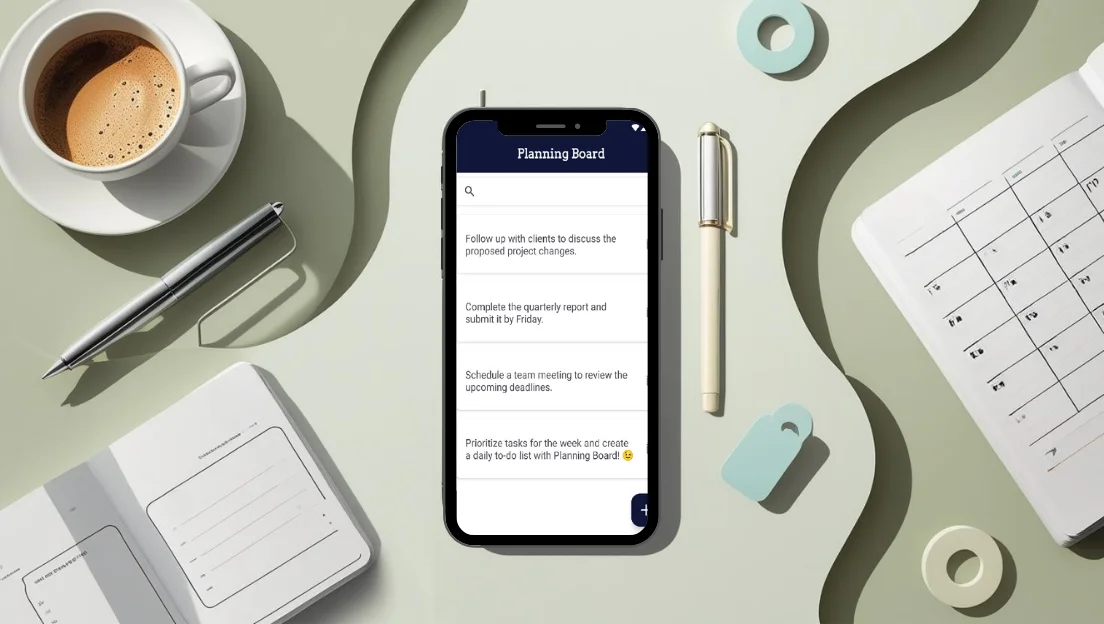
Planning Board is a small Android to-do app written in Java around the standard modern Android stack: MVVM, Room, RxJava and Hilt. The point was to wire those libraries together properly rather than ship a feature-rich product. It has three screens and one table, and every layer between them is explicit, so the wiring is the whole story.
What it does:
- Add a task, edit it, delete it, and search across all of them
- Everything lives in a local SQLite database on the device, with no account and no network. A fresh install opens on an empty list, with Room creating the schema itself
- A blank task cannot be saved: the create and edit screens turn away empty or whitespace-only text with a message, and the prompt in the empty field is a hint rather than text
- Deleting asks first: a Snackbar with a CONFIRM action, on the list and on the detail screen
- Labels and messages, Snackbars included, come from string resources in English and Turkish, and the app follows the device language
A task is one line of text. The Room entity has an auto-generated id and a non-null body and nothing else: no due date, no done flag, no ordering. That keeps the data model out of the way of the architecture, which is what the project is about.
How data moves:
- The DAO returns RxJava 2 types: a Single for reads, a Completable for inserts, updates and deletes
- The repository subscribes on the IO scheduler and observes on the main thread, so no query runs on the UI thread
- Query results go into a LiveData that the repository owns. Hilt provides the repository as a singleton, so the list belongs to the data layer rather than to any one screen
- Every write reloads the list when it completes, and the home screen reloads in onResume as well
- Search runs on every keystroke through SearchView as a LIKE query on the task body and writes into the same LiveData, so the full list and the search results are one stream feeding the same RecyclerView
When something fails: Each RxJava error callback logs the exception and posts a string resource id, wrapped in a one-shot event, to a second LiveData on the repository. Every screen observes it and shows the message in a Snackbar. The wrapper makes sure a message is shown once, not again after a rotation. And because the repository is shared, an error from a save that completes after the create screen has already closed still reaches the home screen.
How it is wired:
- Hilt: One module installed in the singleton component provides the DAO and the repository. Three @HiltViewModel classes, one per screen, receive the repository through constructor injection
- Navigation: One activity hosts three fragments in a single navigation graph. Safe Args passes the selected task to the detail screen as a typed argument rather than as loose Bundle keys, and returning home pops the back stack to a single home screen instead of stacking a new one
- View Binding: Every fragment and the RecyclerView card use generated binding classes instead of findViewById
- Build: Minimum SDK 26, target SDK 33, Java 8 source compatibility, and the Arvo typeface loaded through the Google Fonts provider instead of being bundled
What it leaves out:
- The list is re-read at fixed moments rather than observed as a live query, which is simpler but means the screen reflects the database only when it asks
- Each list update builds a new RecyclerView adapter rather than diffing against the old list
- Constructor injection would let each ViewModel run against a fake repository, but the codebase contains only the template tests Android Studio generates
The result is a reference for the Java version of the modern Android stack, with each library doing one job in a codebase small enough to read end to end.