Getir Clone: Android UI Replication
Getir Clone is a native Android app in Java that rebuilds the Getir home screen with XML layouts, RecyclerView grids and English and Turkish strings.
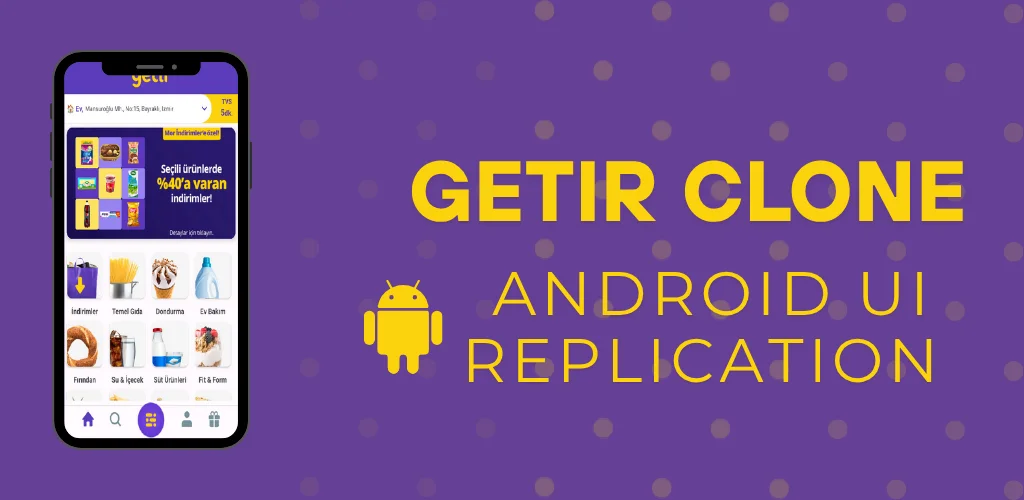
Getir Clone is a native Android app that rebuilds the home screen of the Getir app in Java, with classic Android Views and XML layouts. The project is intentionally scoped to UI rather than backend or business logic. It is one screen, and the work is in the layout: nesting, spacing and colour, plus the two scrolling lists that carry most of the content.
What is on the screen, top to bottom:
- A purple (#5c3cbb) toolbar with the logo centred
- A yellow (#fbd30c) delivery bar: a rounded address card with a sample address in Izmir on one side, the estimated delivery time on the other. Tapping the bar shows a Snackbar with the estimate
- A horizontally scrolling row of campaign banners
- A grid of twelve category tiles, from Discounts and Bakery to Home Care and Ready-to-Eat, laid out in three rows that scroll sideways
- A fixed bottom bar with five icons: home, search, profile, campaigns and a larger centre button
How it is built:
- One activity, one fragment: MainActivity holds a NavHostFragment above the bottom bar, and the navigation graph starts on the home fragment. The bottom bar sits in the activity layout, outside the fragment, so it stays in place if more destinations are added to the graph
- Two RecyclerViews in one ScrollView: The banners use a StaggeredGridLayoutManager with a single horizontal row. The categories use the same manager with three horizontal rows, which produces the column-by-column grid without a custom layout manager
- Data as plain models: Two small Serializable classes, one for campaigns and one for categories, each holding a label and an image name. The fragment builds both lists in code
- Images resolved by name: Each model carries its drawable's name as a string, and the adapter turns it into a resource with Resources.getIdentifier at bind time, so the list data holds no references to generated R fields
- View Binding for the fragment and both card layouts, and CardView with 10dp corners for banners and tiles
- Minimum SDK 24, target SDK 33, Java 8 source compatibility
Two languages: The labels are string resources with an English default and a Turkish translation, for example İndirimler, Fırından and Meyve & Sebze for the categories and TVS for the delivery estimate. The app follows the device language, and the repository includes screenshots of the finished screen in both. The Snackbar text is the one string still hardcoded in English.
What it leaves out:
- There are no product listings, cart, search or account screens. A product detail fragment exists in the navigation graph as an empty placeholder, and nothing navigates to it yet
- The bottom bar icons are images without click handlers
- The address, delivery time, banners and categories are fixed sample data. There is no network layer and no ViewModel
The commit history shows the order the screen was built in: the campaign slider first, then the category grid, then the two lists combined in one scrolling layout, then the launcher icon and translations, and the bottom bar last.
It is useful as a reference for working in pure XML and Views in a codebase where Compose is not yet on the table.