Moody Notes: Note-Taking App for Android
A native Android note-taking app with Firebase sync, offline caching, color tagging, light and dark themes, and five-language localization, built with Kotlin and Jetpack Compose.
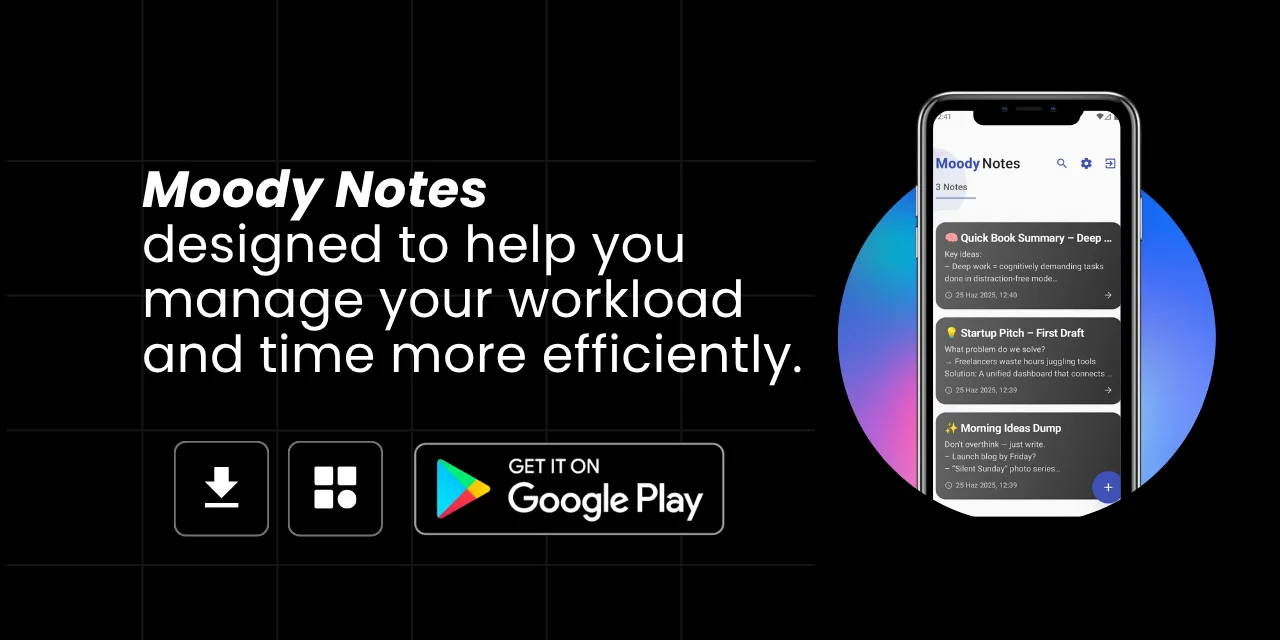
Moody Notes is a native Android note-taking app that handles the parts users notice (sync, offline, search, colors, themes) without the parts they do not (subscription nags, social features, accounts they did not ask for). It runs on Kotlin with Jetpack Compose, syncs through Firebase, and falls back to local storage when the device is offline. It has been on Google Play since May 2020 and is still maintained: the listing shows version 3.1.1, updated in January 2026.
What the app does:
- Create, edit, delete, and search notes
- Tag notes by color for quick filtering
- Sync across devices through Firebase Firestore in real time
- Work offline through local caching and sync changes when the connection returns
- Authenticate with email and password or stay anonymous through Firebase Auth
- Switch between light and dark themes manually or follow the system setting
- Display the UI in Turkish, English, German, French, or Spanish
Accounts and data: Notes live in Firebase, Google's backend, and an account is what carries them from one phone or tablet to another. The Play data-safety declaration lists two kinds of personal data, a name and an email address. Both are optional, both are used only for account management, and neither is shared with other companies.
Deleting an account: The store requires a published way to delete an account and its data. For Moody Notes that is a form on this site, and it is built so that knowing someone's email address is not enough to delete their notes.
- The form takes a name, the email on the account and an optional reason. Submitting it deletes nothing. It sends a confirmation link to that address
- The link is valid for 24 hours and works once. The token in it travels in the URL fragment, which browsers never send to a server, so it stays out of access logs and Referer headers, and the page strips it from the address bar as soon as it loads
- Opening the link is not enough: confirmation is a button press, because mail scanners open links to inspect them and an automatic confirmation would let a scanner delete an account
- The request reaches me only after that press, in a message that records the proof and when it was given
- The server stores only a hash of each token, so a leaked store yields no working links. Confirmation emails to the same address are at least 15 minutes apart, and every accepted request gets the same answer, so the form does not reveal whether an address was used recently
The consent checkbox on the form is never sent. It makes the person pause on an irreversible request. The proof is the emailed link.
How it is built:
- MVVM with Clean Architecture: Layered structure that keeps the UI free of network and persistence concerns
- State management: ViewModel and StateFlow, with Compose collecting state streams directly
- Coroutines and Flow: Async work and reactive streams without RxJava
- Hilt: Dependency injection for repositories, use cases, and ViewModels
- Timber: Structured logging that stays out of release builds
- Jetpack Navigation: Type-safe routing between screens
Recent changes: The latest update notes list a revamped interface, support for more languages, performance work and bug fixes. The app requires Android 7.0 or later, and its privacy policy and terms are published on this site.